5pm Tuesday Nome–Dallas widens gap on following Pack by Joe Runyan
5
PM Tuesday Nome— Dallas widens gap on following Pack—by Joe Runyan
Dallas Seavey through Safety, and expected Nome after 6PM. In a
flurry of activity, the city of Nome blankets mainstreet with snow, then
levels with a grader. The entry chute and the famous Burled
Arch—recall statements and cliches in previous year’s such as “John
Baker’s leaders just passed under the Burled Arch, making him the winner
of the 2011 Iditarod”—are vacant, ready to be populated by VIP’s with
special badges, selected media, officials, camera guys, and the winner’s
family.
In the city hall, our crew is emersed in the bedlam of live
broadcast chaos as microphone connections, video quality are checked for
final minute corrections.
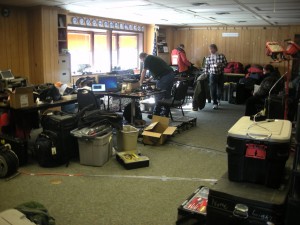
the nerve center, preparing for insider broadcast
Earlier, I flew over Dallas just as he was topping Topkok hill and
minutes away from a descent to the beach line to Nome. On the internet,
some of my more astute observers are telling me that Dallas is widening
his gap on aliy Zirkle, in second, and Ramey Smyth, working hard to get
some leverage on 2
nd place.
Coincidentally, I bump into Jerry Miller, the Ionearth concept man
and owner, who tells me that Smyth and Zirkle are virtually lock
stepped. However he confirms that Dallas Seavey, in spite of a
monstrously abused big toe on his left foot, has expanded his lead from
about 7 miles to 14 miles. Does anyone doubt but that he is running,
poling, and kicking as the 10 th dog?
Concurrently, a local tells me that his associates think the GPS is
off two miles since Safety, the local land mark, is shown as 22 miles
instead of 20 miles. We checked with the trail breakers, however, and
are told that they decided to change the route AROUND the Cape, as
originally shown on the IONesrth map. But, then again, who cares, since
we do know that a 2.5 hour run would be sensational for Dallas.The
earliest we anticipate a finish is 6:30, a best guess estimate.
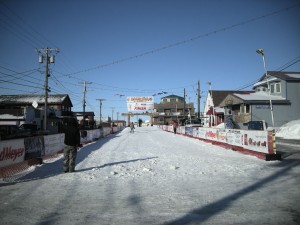
The finish chute in Nome, installed by city machinery
Then, fortuitously, I see Jeanine Seavey and immediately congratulate
her son’s lead position. She told me that it was absolutely true that
his victory represents a detailed management strategy, to include his
athleticism, rather than a raw demonstration of canine athletes. “Most
of his dogs were rejected by his father (Mitch the Elder). But he has
an intensity we’ve known about for a long time. A month before the
Iditarod, Dallas’ wife Jen said, “He’s going to win the Iditarod this
year.”
Dallas does have dogs that he raised, but they are too young to
race. His present team is composed of dogs he has collected from other
kennels.
My own ideas
I have my own ideas about Dallas’ success after watching him emerge
in the front pack days ago in Takotna, then gradually work his way to
the front at Unalakleet. At one point I remember talking to Dallas in
Ruby, the first checkpoint on the Yukon, uncertain about how he
mathematically could advance to the front. “Oh yeah,” he told me,
“absolutely, its all possible. It will take two days, but I’ll be
there.” In Kaltag, further up the trail, he was staged to go even with
Aliy, at that time, telling me, “I am not sure that the front runners
have correctly identified who they are racing with.” Thus, he carefully
rested and eyeballed Aaron Burmeister, John Baker (who he rightfully
respects) in addition to front runner Aliy Zirkle.
Honestly, it’s fair to say that Dallas team is not distinguished by
raw physical ability. Most would agree that many teams on this years
race represented more athletic combinations, but Dallas was able to one
up them with a disciplined strategy , training, and scrupulous dog
care.
First, he decided in training to accustom the dogs to relatively
short four to six hour runs, punctuated with snacks every two hours
(never fall behind on calorie intake), and the assurance that a rest
break would fall consistently with a hot meal (keeps dogs calm, also
assures hydration).
Next, he committed to scrupulous dog care, checking boots every two
hours, changing if necessary, and requisite training so they were
prepared for the race schedule.
Noticeably, he regarded the event as an athletic event, not a game
played with animals, inserting himself into the equation as an active
participant. This discipline he inherited from his experience as a
nationally wranked wrestler. Therefore, he ran hills, worked behind the
sled, and hustled in checkpoints like it was a two minute drill.
Finally, he developed a checkpoint regimen that gained him minutes.
“I raced my own dad preseason, and even though his team was faster, I
was better at resting my team and gaining minutes in the checkpoint.
At the end, I would end up in the same place, so that demonstrated how
important efficiency can be in determining time.” Following the race,
all my race pundits agreed that his checkpoint efficiency was first as
he worked without wasted movement up and down his row of dogs in an
orchestrated plan.
From my viewpoint, I enjoyed Dallas Seavey’s habit of reciting his
mental plan if anybody had the interest to ask. Focused so entirely on
the task, I think he used it as an opportunity to verbally rehears e
and review his game plan. Its actually a valuable trait to visualize
and repeat a protocol. After a while, it becomes second nature.
Final Thoughts
Race historians are presently delving into birth records to determine
whether 5x champ Ric Swenson or Dallas Seavey is the youngest champ.
In the present age of the Iditarod, he represents an anomaly, since the
development of a great kennel takes years and we usually expect to see
older mushers.
Instead, Dallas assembled some good canine athletes, designed a
realistic plan, and had the discipline to execute his vision. Welcome
the 2012 Iditarod champ.


